
Rybchynskyi, O.
(2023).
Frontline town centres within the area of the Hirskyi Tikych river.
Architectural Studies,
9(1),
36-46.
https://doi.org/10.56318/as/1.2023.36
Article
Frontline town centres within the area of the Hirskyi Tikych river
Abstract
The study presents the history of the emergence, development and decline of the frontline towns concentrated in the area of the Hirskyi Tikych River. The research focuses on Buzivka, Buky, Vorone, Zelenyi Rih, Zubrykha, Okhmativ, Sokolivka and Monastyryshche. Natural factors and the branching of the Black Way determined the concentration of settlements in the river area. The study of the frontline towns is relevant due to the peculiarities of urban processes in Central Ukraine and is important for the development of historical and architectural reference plans. The research aims to determine the spatial features of the city centre in the cities of the right-bank Ukraine frontier in the seventeenth and eighteenth centuries. In the course of the study, the methods of analysis (for literary sources), comparative analysis (for the cartography of different times), and a set of field studies were used. The studied towns had an optimal defensive perimeter dominated by a Ukrainian wooden church, and a key element of the spatial image was a residential wooden house. It is determined that the cities of the frontier had political and cultural conflicts with the centre of the state, which caused the loss of the role of settlements and the division of the Polish-Lithuanian Commonwealth in the late seventeenth century. Based on historical cartography, source material, and the preserved ancient street network, the urban planning features of the town centres are localised and identified. The frontier towns concentrated in the area of the Gorny Tikich River were economically and culturally united and were characterised by rational planning. Improvements in the town centres of the frontier towns are linked to the political and economic intentions of magnates in the late sixteenth and early seventeenth centuries. The spatial layout of the town centre was centred around a Ukrainian wooden church, except Monastyryshche, which also had a wooden church in the town centre. The main building element was the Ukrainian wooden house, which defined the spatial and cultural image of the settlement. Due to the uncertain political boundaries and the division of the Polish-Lithuanian Commonwealth in the late seventeenth century, the frontier towns lost their significance. In the nineteenth century, except for Monastyryshche, all settlements declined economically and administratively. The practical value of the study lies in the fact that the results can be used in the development of historical and architectural reference plans, revitalisation projects for the centres of historic towns, downtown regeneration projects, and the commemoration of lost important monuments. The research materials can be used in a course on the history of urban planning and architecture of Ukraine, as well as in the development of tourist and recreational routes
Keywords
area; location; culture; urban planning; church; market square; defensive perimeter
Received 20.04.2023, Revised 01.06.2023, Accepted 25.06.2023
Retrieved from Vol. 9, No. 1, 2023
Suggested citation
https://doi.org/10.56318/as/1.2023.36
Pages 36-46
References
[1] Archive of south-western russia. (1869). City acts 1432-1798 (pp. 388-390). Retrieved from http://resource.history.org.ua/item/0006718.
[2] Archive of south-western russia. (1886). Acts of settlement in south-western russia (Vol. 1). Retrieved from http://resource.history.org.ua/item/0006723.
[3] Bevz, М. (2022). Analysis of the architectural and planning structure and fortification objects of the city of Lviv according to the map of Zhan Doetch, 1770 (1750). Current Issues in Research, Conservation and Restoration of Historic Fortifications, 17, 162-187. doi: 10.23939/fortifications2022.17.162.
[4] Chukhlib, Т.V. (2009). The response of the governments of Ukraine to the Andrusiv armistice of 1667 between Moscow and Warsaw. In Cossacks and monarchs. International relations of the early modern Ukrainian state 1648-1721 (pp. 137-151). Кyiv: Olena Teliga Publishing House.
[5] Chukhlib, Т.V. (2011). Peace of Polyanivskyi 1634. In Encyclopedia of the history of Ukraine (Vol. 8; pp. 411-412). Кyiv: Naukova dumka. Retrieved from http://resource.history.org.ua/item/0007074.
[6] Geuze, A., & Vasini, D. (2018). Frontier city: Strategies for Boston Harbor. Cambridge: Harvard University Graduate School of Design.
[7] Gitlin, J., Berglund, B., & Arenson, A. (2013) Frontier cities: Encounters at the crossroads of empire. Philadelphia: University of Pennsylvania Press.
[8] Havryliuk, І. (2014). Vladyslav Dominik Zaslavskyi (1616-1656): Tycoon, politician, military leader. Special Historical Disciplines, 22-23, 83-110. Retrieved from https://heritage.oa.edu.ua/assets/files/havryliuk_VDZ.pdf.
[9] Hrushevsky, M. (1907). History of Ukraine-Rus (Vol. 4). Kyiv. Retrieved from http://resource.history.org.ua/item/0007714.
[10] Jablonovsky, A. (1897). Historical sources (Vol. 22). Warsaw. Retrieved from http://hrushevsky.nbuv.gov.ua/item/0009569.
[11] Lytvynchuk, І. (2021). Historical and town-planning studies of defense complexes of the city of Vinnytsia of the Russian-Lithuanian era (XIV-XVI centuries). Current Issues in Research, Conservation and Restoration of Historic Fortifications, 14, 74-89. doi: 10.23939/fortifications2020.14.074.|
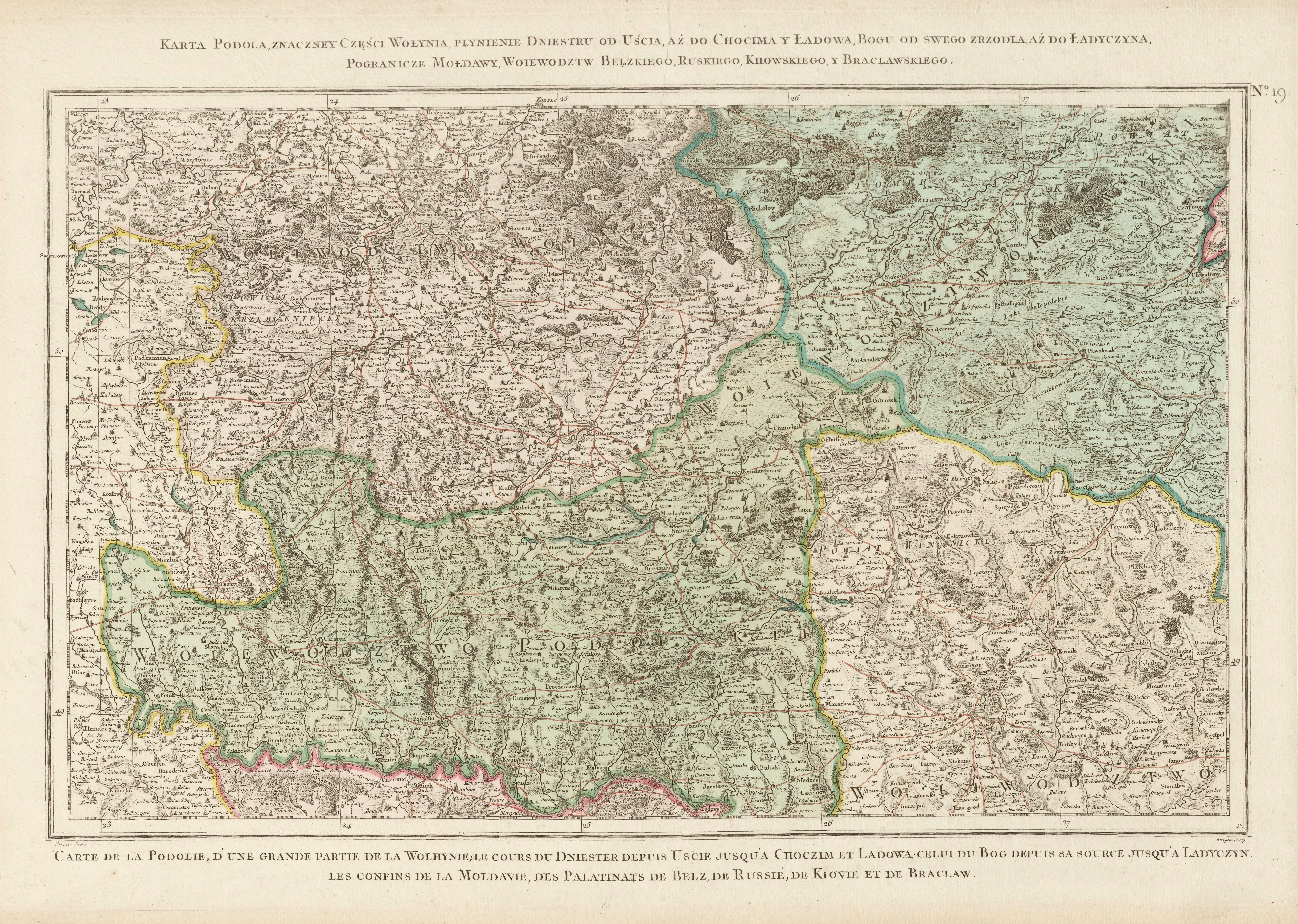
[12] Map by Giovanni Antonio Rizzi Zanoni from the second half of the 18th century. (n.d.). Retrieved from http://maps.mapywig.org/m/Polish_maps/series/690K_Zannoni_Carte_de_la_Pologne/Zanonni_Carte_De_La_Pologne_sbc37480_Nr_19_Karta_Podola_znaczney_Cz%C4%99%C5%9Bci_Wo%C5%82ynia.jpg.
[13] Map by Guillaume Levasseur de Beauplan from the mid-17th century. (n.d.). Retrieved from https://baitsar.blogspot.com/2017/01/xvii-c.html.
[14] Martinez, M.-V. (2006). From the notion of border city to that of border in the city. Cahiers de la Méditerranée, 73, 19-46. doi: 10.4000/cdlm.1362.
[15] Nugent, P. (2012). Border towns and cities in comparative perspective. In T.M. Wilson, & H. Donnan (Eds.), A companion to border studies. Chichester: Wiley-Blackwell.
[16] Plokhij, S. (2009). Gadyach 1658: Creation of a myth. In Hadiac union of 1658: Controversies of the past and the present. A collection of articles based on the materials of the International Scientific Conference (pp. 5-23). Retrieved from https://chtyvo.org.ua/authors/Zbirnyk_statei/Hadiatska_uniia_1658_roku_kontroversii_mynuloho_i_suchasnist/.
[17] Pokhylevych, L. (1864). Legends about the populated areas of the Kyiv province. Kyiv: Printing house of the Kyiv Pechersk Lavra. Retrieved from http://irbis-nbuv.gov.ua/ulib/item/UKR0002928.
[18] Reitel, B., Zander, P., Piermay, J.-L., & Renard, J.-P. (2002). Villes et Frontières. Paris: Anthropos.
[19] Ruda, О.V. (2008). Brest Union in the studies of Lviv Polish historians (1890-1914). Problems of Slavic Studies, 57, 63-72. Retrieved from https://shron1.chtyvo.org.ua/Ruda_Oksana/Beresteiska_uniia_u_doslidzhenniakh_lvivskykh_polskykh_istorykiv_18901914.pdf?.
[20] Rychkov, P. (2020). Urban cartography of the city of Izyaslava: Second half. XVIII - beginning XIX century. Collection of Scientific Papers, 7, 93-113.
[21] Sas, P.М. (2010). Zaporozhians in the Polish-Moscow war at the end of the troubles of 1617-1618. Bila Tserkva: O.V. Pshonkivskyj. Retrieved from http://irbis-nbuv.gov.ua/ulib/item/ukr0010562.
[22] Sohn, C., & Lara-Valencia, F. (2013). Borders and cities: Perspectives from North America and Europe. Journal of Borderlands Studies, 28(2), 181-190. doi: 10.1080/08865655.2013.854662.
[23] Sulimierski, F., & Walewski, W. (1880). Geographical dictionary of the Kingdom of Poland and other Slavic countries. Warsaw: Wieku.
[24] Tronko, P.T., & Steshenko, O.L. (1972). History of cities and villages of the Ukrainian SSR: Cherkasy region. Kyiv. Retrieved from http://irbis-nbuv.gov.ua/ulib/item/UKR0001262.
[25] Vechersky, V. (2022). Preservation of the historical urban environment in the grip of old mistakes. Current Issues in Research, Conservation and Restoration of Historic Fortifications, 16, 6-14. doi: 10.23939/fortifications2022.16.006.
[26] Velychko, S. (1991). Chronicle. Kyiv: Publishing house of fiction “Dnipro”. Retrieved from http://resource.history.org.ua/item/0009325.
[27] Yakovenko, N. (2008). Ukrainian nobility from the end of the 14th to the middle of the 17th century. Volyn and Central Ukraine. Kyiv: Krytyka. Retrieved from https://archive.org/details/ukrajinska-shljaxta-volyn-centralna-ukrajina-2008/mode/2up.